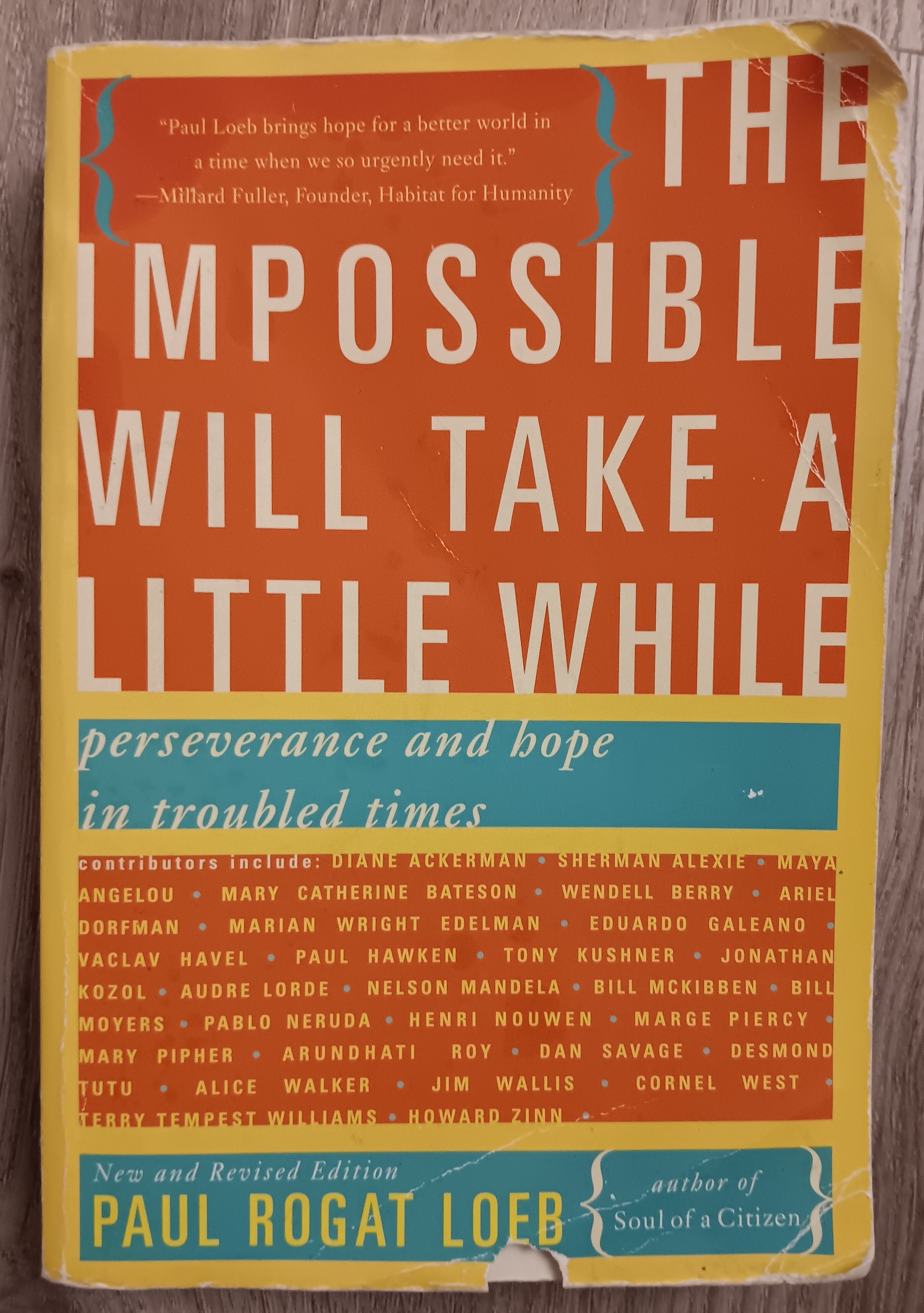
The subtitle of this book is “perseverance and hope in troubled times.” That’s what it felt like. I do a lot of my reading on my bus commute, sitting down with a book for 45 minutes, but I realized early on that I couldn’t do that with this book, because each essay is so good; I needed to sit with them. So I slowed down and read just one essay at a time so I could absorb as much as I could. The authors included in the book come from varying backgrounds and perspectives, and yet they all helped me to feel like I could persevere and find hope. Or perhaps most interesting to me was the idea of moving beyond hope. In a section with that title, Paul Loeb writes, “there is even a kind of hope beyond hope, which happens only when we’re willing to act whether or not we ever see results” (p. 376). It’s the idea that when I feel like the world is just too terrible, I don’t truly hope things will be better, yet I still work towards the better world because that’s what I need to do.
This 2014 revised edition was an update from the original 2004 version, and even 10 additional years on from that, the book still feels like it was written for these times. It’s the book I couldn’t stop talking about in 2023, and I will definitely be revisiting it.
Quotes
“As I write, I don’t know what will finally happen with the tar sands, but I do know what has happened to me. I do this work because acting as if I have hope gives me hope. The process of trying to make things better is the healthiest way I have of responding to the world around me.” – Mary Pipher, p. 121
“She said, ‘You know I cannot save them. I am not here to save anybody or to save the world. All I can do — what I am called to do — is to plant myself at the gates of Hope. Sometimes they come in; sometimes they walk by. But I stand there every day and I call out till my lungs are sore with calling, and beckon and urge them in toward beautiful life and love.'” – Victoria Safford, p. 228
“These and other projected impacts of climate change are more than worrisome — they are so potentially overwhelming that people can feel that it’s futile to resist. What difference can one person make against a problem so big and relentless? Easy at it is to succumb to despair, we can’t afford it. Take comfort instead in the imperative of hope, which I define as an active, determined conviction to work for what is right, even in the face of long odds.” – Mark Hertsgaard, p. 281
“If some of the poorest people on Earth can achieve so much in the face of climate change, surely those of us who enjoy more comfortable circumstances should be able to do our part, no?” – Mark Hertsgaard, p. 284
“We need a moral prophetic minority of all colors who muster the courage to question the powers that be, the courage to be impatient with even and patient with people, and the courage to fight for social justice.” – Cornel West, p. 346
“Because our society has preferred continuous versions of stories, discontinuities seem to indicate that something is wrong with you. A discontinuous story becomes a very difficult story to claim.” – Mary Catherine Bateson, p. 367
“‘We activists,’ Naomi Klein writes, ‘whether grassroots organizers, researchers, or theorists, tend to hop from one atrocity to the next — sweatshops, poisons, sickness, war — until we are pickled in horrors. Gradually, our beliefes, rather than flowing from love for what we are protecting or building, start to flow from more dangerous sources: rage and bitterness.'” – Paul Loeb, p. 416
 Amy Bergstrom